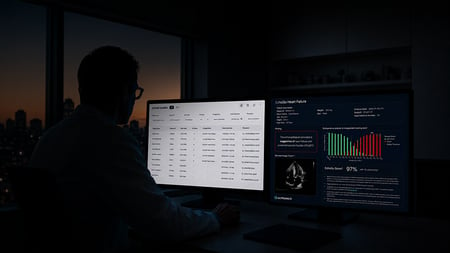
Echogo® Heart Failure
HFpEF detection
Advanced AI for identifying patients with HFpEF
- check FDA-cleared
- check Seamless integration with echo workflows
- check Live in top U.S. hospitals
- check Incremental reimbursement
HFpEF is challenging to detect
HFpEF is one of the most common and most underdiagnosed forms of heart failure. Symptoms are often non-specific, routine tests can be inconclusive, and many patients remain undiagnosed until later in their disease journey.⁵˒⁶
HFpEF flagged from a single echo scan
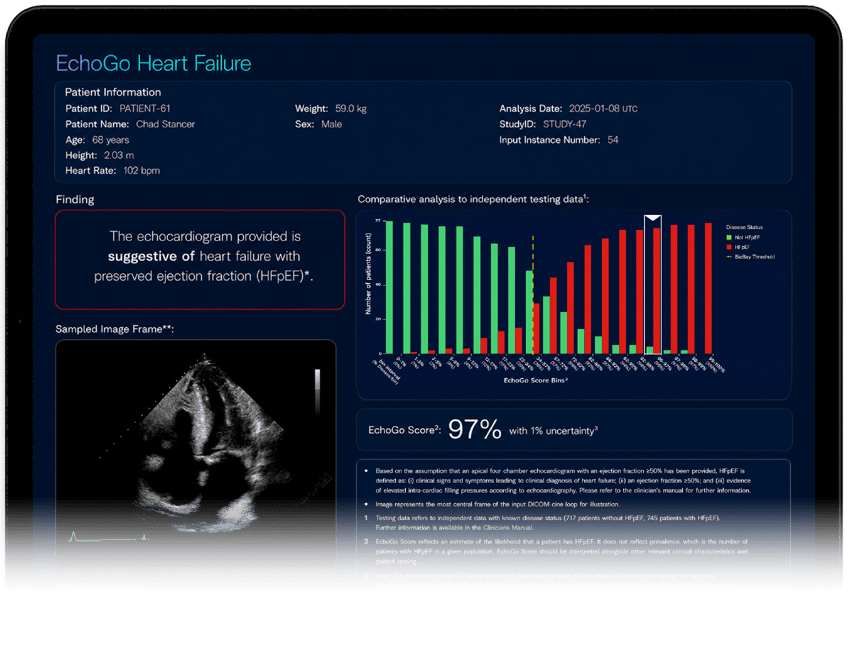
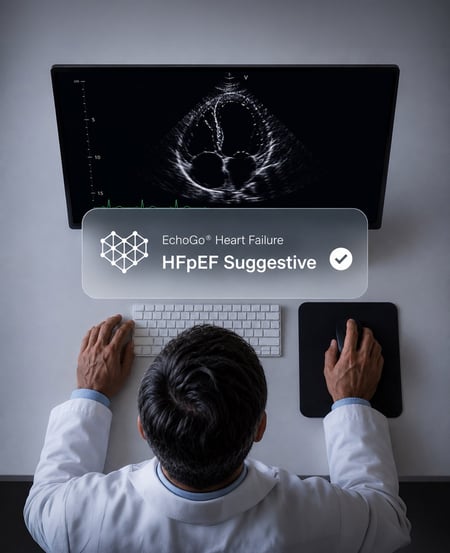
EchoGo® Heart Failure analyzes a single apical four chamber view to flag HFpEF right inside the echo workflow, helping clinicians identify patients who may benefit from further assessment.
Clinically proven, FDA-cleared, live in U.S. hospitals, and supported by incremental reimbursement.⁷⁻⁹
Built around the way echo teams already work
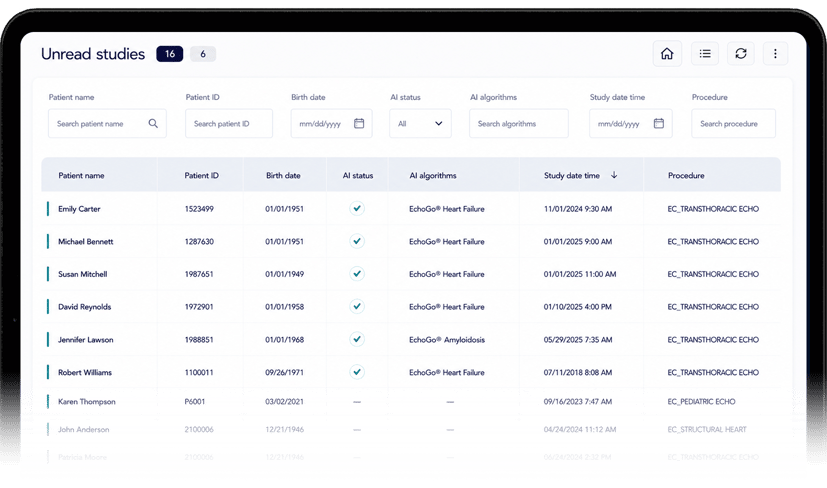
EchoGo® Heart Failure findings are returned directly into existing clinical systems, allowing clinicians to review AI results alongside routine echocardiography studies with no additional workflow steps require.
Dr. Faizi Jamal on using EchoGo® Heart Failure at City of Hope
See how City of Hope is integrating EchoGo® Heart Failure into routine echocardiography workflows to support HFpEF detection and timely intervention.
Look beyond HFpEF
Studies suggest that approximately 14% of patients with HFpEF may have underlying cardiac amyloidosis.¹⁰
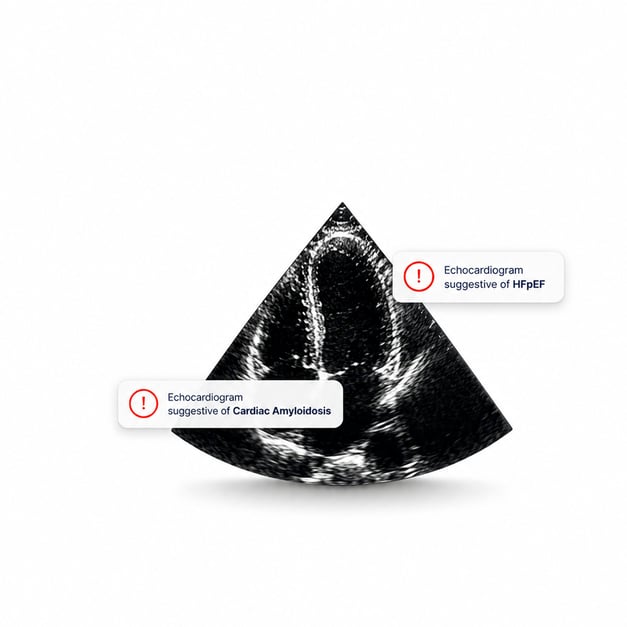
By identifying patients with suspected HFpEF, EchoGo® Heart Failure can help create an enriched population for cardiac amyloidosis screening, connecting directly to EchoGo® Amyloidosis within the same echocardiography workflow.
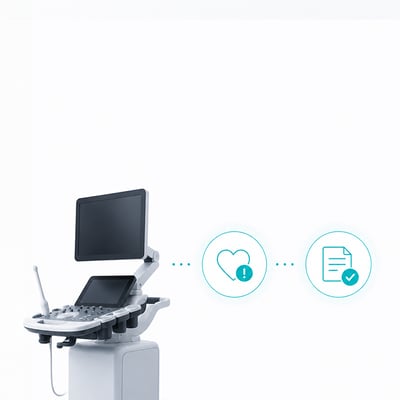
Every echo is automatically
analyzed for HFpEF.
Findings returned for
clinical review.
Cardiac amyloidosis
screening included.
HFpEF findings available
in less than 20 minutes.
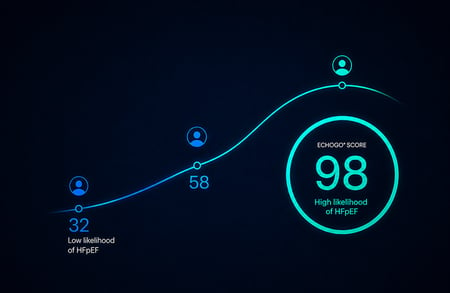
See your patient's
likelihood of HFpEF.
See where Ultromics' AI supports the clinical care pathway
Explore clinical scenarios where Ultromics' technology helps clinicians recognise HFpEF and cardiac amyloidosis early from routine echocardiograms.
Multiple echocardiograms.
Repeated admissions.
Late diagnosis
A 70-year-old Caucasian male presented with shortness of breath and a new murmur. His history included atrial fibrillation, hypertension, and hyperlipidemia.
Across several years, the patient experienced repeated hospitalizations, worsening symptoms, and multiple inconclusive evaluations. Echo findings showed progressive LVH, bi-atrial enlargement, worsening EF, and aortic stenosis, but the true underlying disease remained unconfirmed.
The diagnostic challenge
The patient’s symptoms and imaging findings were non-specific and evolved over time. Despite multiple echoes, hospitalisations and follow-up visits, the true diagnosis was not achieved until 2025.
Findings were interpreted through several possible clinical pathways, including aortic stenosis and HOCM, but the underlying cardiac amyloidosis remained elusive for at least 4 years.
Patient snapshot
- 70-year-old Caucasian male
- History of atrial fibrillation, hypertension and hyperlipidemia
- Indication: murmur and shortness of breath
Clinical journey
Over the course of hospitalizations and procedures, the patient received echocardiograms in 2020, 2021, 2022, 2023, 2024, and 2025. With the implementation of EchoGo® Amyloidosis, the patient’s echo was flagged as “suggestive of cardiac amyloidosis” in 2025, when his LVEF had deteriorated to ~30-35%
The patient then received a diagnostic work-up including PYP and was confirmed to have ATTR-CM.
Retrospective review of his five previous echo studies show that EchoGo® Amyloidosis would have flagged the underlying cardiac amyloidosis beginning with his echo in 2021, earlier in the disease progression when his LVEF was preserved at ~50-55%.
Key clinical pattern
- 4 hospitalisations
- Multiple follow-up visits
- Inconsistent and variable echo measurements
- Worsening symptoms over time
- Diagnosis delayed until 2025
EchoGo® Amyloidosis result
Suggestive of Cardiac Amyloidosis
EchoGo® Amyloidosis identified findings “suggestive of cardiac amyloidosis,” helping surface a disease signal that had remained hidden across years of clinical evaluation.
What EchoGo® Amyloidosis could have changed
Had EchoGo® Amyloidosis been used earlier in the patient’s echo journey, the finding “suggestive of cardiac amyloidosis” could have helped prompt earlier diagnostic review, specialist follow-up, and confirmatory testing.
Instead of multiple years of worsening symptoms and inconclusive evaluations, EchoGo® Amyloidosis could have provided an additional disease-specific signal to support earlier recognition of an often-missed cause of heart failure and mortality.
Borderline Findings.
Unexplained breathlessness.
A 64-year-old African-American woman presented with progressive shortness of breath and reduced activity tolerance, saying she "can't do as much as I used to."
Her history included atrial fibrillation, hypertension and obesity. Her echocardiogram showed a preserved EF of 50–55%, LV wall thickness of 1.2 cm, mild AS and mild bi-atrial enlargement.
The diagnostic challenge
Standard assessment left uncertainty. Under the 2016 ASE Guidelines for Diastolic Dysfunction, the result was indeterminate. With the 2025 ASE guideline updates, several measurements remained borderline, meaning variability could place the patient in either grade 1 or grade 2 diastolic dysfunction. Atrial fibrillation and obesity made her echo more challenging to interpret.
Patient snapshot
- 64-year-old African-American female
- History of atrial fibrillation, hypertension and obesity
- Indication: shortness of breath
EchoGo® Heart Failure result
Suggestive of HFpEF
EchoGo® Heart Failure identified findings suggestive of HFpEF, helping move the case from uncertainty to a clearer path for clinical follow-up.
EchoGo® Heart Failure provided the care team information so they could move beyond an indeterminate guideline result and consider targeted follow-up sooner.
Instead of leaving unexplained breathlessness in a diagnostic grey zone, EchoGo provided an additional disease-specific signal to support earlier recognition, clearer clinical decision-making and more timely management.
Looked like HCM. Actually Cardiac Amyloidosis.
A 73-year-old man self-referred for specialist assessment after being followed elsewhere for eight years with a presumed diagnosis of hypertrophic cardiomyopathy (HCM).
His imaging findings appeared consistent with HCM, and the diagnosis remained unchanged for years. Further evaluation at Mayo Clinic ultimately revealed hereditary ATTR cardiac amyloidosis, highlighting how amyloidosis can closely mimic other cardiac conditions on echocardiography.
The diagnostic challenge
Cardiac amyloidosis and HCM can share similar imaging features, including increased wall thickness and overlapping echo phenotypes.
In this case, the patient's presentation was managed as HCM for eight years before advanced testing demonstrated the true underlying disease.
Patient snapshot
- 73-year-old male
- Followed elsewhere for 8 years with presumed HCM
- Self-referred for specialist HCM assessment
- Final diagnosis: hereditary ATTR cardiac amyloidosis
Key findings
- Increased wall thickness
- HCM-like echocardiographic phenotype
- Extensive late gadolinium enhancement on CMR
- Positive PYP scan for transthyretin amyloidosis
- RV biopsy showed no myocyte disarray
- TTR confirmed by mass spectrometry
- Genetic testing confirmed hereditary ATTR amyloidosis (Val124-TTR)
EchoGo Amyloidosis result
Suggestive of Cardiac Amyloidosis
EchoGo Amyloidosis identified findings suggestive of Cardiac Amyloidosis directly from the echocardiogram, despite the patient's longstanding presumed diagnosis of HCM.
What EchoGo Amyloidosis could have changed
Had EchoGo Amyloidosis been used earlier in the patient's clinical journey, the finding suggestive of Cardiac Amyloidosis could have prompted earlier consideration of infiltrative heart disease and additional confirmatory testing.
Rather than remaining on an HCM pathway for years, EchoGo could have provided an additional disease-specific signal supporting earlier recognition of hereditary ATTR cardiac amyloidosis and more timely access to appropriate treatment and family screening.
CLINICALLY EVALUATED
Trained, validated and independently tested on real world cases.
EchoGo® Heart Failure was trained, validated, and tested on real world outcomes in partnership with Mayo Clinic to accurately identify HFpEF.
Performance has been evaluated in both peer-reviewed studies and real-world clinical settings.⁷˒⁸
PEER-REVIEWED
JACC Advances + JASE
Clinical Sites
Mayo Clinic
real-world cases
10,000+

In clinical evaluation under intended-use conditions, EchoGo® Heart Failure demonstrated 90.3% sensitivity and 86.1% specificity. See FDA 510(k) K240013 for full results.
Featured in respected journals.
ASE GUIDELINES
Cited in the 2025 ASE diastolic function guidelines.
EchoGo® Heart Failure pivotal study is citied in the 2025 ASE Guidelines for Diastolic Function Assessment and HFpEF Diagnosis, recognizing the emerging role of AI in supporting diagnostic assessment from routine echocardiography. ¹¹
CUSTOMER ONBOARDING
Deploy with confidence. Simple onboarding. Designed to fit your workflow.
-
Step 01 - Discovery
Understand requirements, infrastructure, and workflow.
-
Step 02 - Connect
Establish secure connectivity and configure DICOM routing.
-
Step 03 - Go live
Begin receiving AI findings from Ultromics directly into your existing clinical systems.
-
Step 04 - Scale
Expand across sites, workstations, and clinical teams.
Automated from analysis to billing.
End-to-end automated workflow, from study analysis and report delivery through to automated billing.
Built to scale across echo labs and health systems.
Cloud-based infrastructure designed to scale across echo labs, hospitals, and health systems, from one site to enterprise-wide adoption.

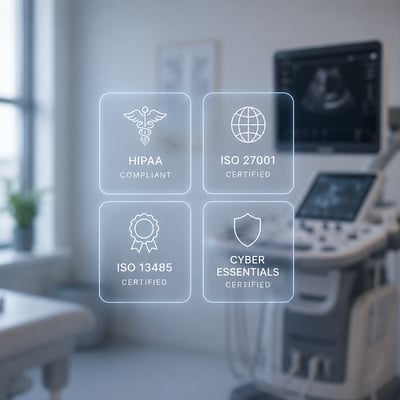
Designed for secure healthcare deployment.
HIPAA compliant, Cyber Essentials certified, ISO 27001 certified, and ISO 13485 certified.
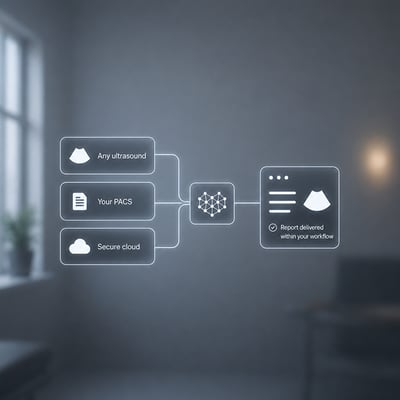
Integrated into the workflow you already run.
Connects with ultrasound systems and PACS through secure cloud infrastructure, with no disruption to how your team works.
Still got questions?
Speak with a local rep in your area to learn more. Contact us.
-
What is EchoGo® Heart Failure?
EchoGo® Heart Failure is an FDA-cleared AI solution that analyzes a single apical four-chamber echocardiography view to help identify patients with HFpEF.
-
How accurate is EchoGo® Heart Failure?
In published clinical studies, EchoGo® Heart Failure demonstrated 90% sensitivity and 86% specificity for HFpEF detection
-
How does EchoGo® fit into existing echo workflows?
Studies are automatically routed for AI analysis, with findings returned directly into existing clinical systems. No new hardware, scanning protocols, or workflow changes are required.
-
How quickly are results available?
Reports are typically returned in less than 20 minutes and are available during routine echo interpretation.
-
Is EchoGo® Heart Failure FDA cleared?
Yes. EchoGo® Heart Failure is FDA cleared and is indicated as a diagnostic aid to support HFpEF identification.
-
Is reimbursement available?
Yes. EchoGo® has an assigned CPT code (0932T), supporting reimbursement across multiple care settings
EchoGo® Heart Failure 2.0 is FDA 510(k)-cleared. Rx only, for use by or on the order of a physician. Available in the United States only.
¹ Hahn VS et al. JACC: Heart Failure. 2020;8:712-724.
² Borlaug BA et al. Journal of the American College of Cardiology. 2023;81:1810-1834.
³ González-López E et al. European Heart Journal. 2015;36:2585-2594.
⁴ AbouEzzeddine OF et al. JAMA Cardiology. 2021;6:1267-1274.
⁵ Pfeffer MA et al. Circulation Research. 2019;124:1598-1617.
⁶ Rozenbaum MH et al. Cardiology and Therapy. 2021;10:141-159.
⁷ Akerman AP et al. JACC Advances. 2023;2:100452. doi:10.1016/j.jacadv.2023.100452.
⁸ Cassianni C et al. Journal of the American Society of Echocardiography. 2024;37:914-916. doi:10.1016/j.echo.2024.06.016.
⁹ EchoGo® Reimbursement Guide. CPT® code 0932T assigned for EchoGo® Heart Failure and covered under APC 5743 across applicable outpatient, physician, and office reimbursement pathways.
¹⁰ Nagueh SF et al. Journal of the American Society of Echocardiography. 2025;38:537-569.
Ready to see EchoGo® Heart Failure in practice?
Speak with a local rep in your area to learn more.